According to the Special Development Plan for the Special-Purpose Vehicle Industry under the 14th Five-Year Plan (2021–2025), the overarching idea for the development of China’s special-purpose vehicle industry during the 14th Five-Year Plan period is to follow the development philosophy of “innovation, coordination, green development, openness and sharing”; center on high-quality development of the entire industrial chain; focus on four major development areas; cultivate five key categories of dedicated components and raw materials; prioritize the implementation of five major projects; and build special-purpose vehicle industry clusters with complete industrial chains, diverse product varieties, rich markets, outstanding competitiveness and distinctive cluster characteristics.
At the same time, the industry will seize the historic opportunities presented by major national strategies, with emphasis on breakthroughs in transformation, innovation-driven development, green development and the overall upgrading of special-purpose vehicles. It will focus on key special-purpose vehicle segments, highlight its distinctive features, amplify its advantages, restructure, optimize its layout and adhere to a high-end development strategy, centering on high-quality development and using the coordinated development of industrial clusters as the means to make special-purpose vehicles that are truly “special-purpose” better and stronger.
Below is the analysis of the overall development environment from the Special Development Plan for the Special-Purpose Vehicle Industry under the 14th Five-Year Plan (2021–2025), as excerpted by a reporter from Special Purpose Vehicle magazine.

Macroeconomy:
An overall stimulus to the upward development of China’s special-purpose vehicle industry
It is generally believed that the domestic special-purpose vehicle industry is heavily influenced by the macroeconomy and that its market conditions are closely linked to GDP performance. Here, the trends in domestic special-purpose vehicle output growth and GDP growth during the 13th Five-Year Plan period are compared (see Figure 1).
Looking at the overall trend, domestic special-purpose vehicle output has risen sharply year after year, while GDP growth has been relatively moderate, and the growth in special-purpose vehicle output has not shown a close correlation with GDP growth.
Analysis points to two reasons. First, the special-purpose vehicle industry is relatively niche and is part of the automotive industry; its production and sales volumes are negligible compared with the industries that drive GDP trends, so it has little impact on the macroeconomy.
Second, some individual products in the special-purpose vehicle industry are relatively sensitive to macroeconomic trends and strongly affected by the macroeconomy, but they account for a relatively small share of output, so this is not clearly reflected in the overall trend of special-purpose vehicle output data.
During the 13th Five-Year Plan period, despite a complex and intricate international economic situation, China’s economy maintained a development trend of overall stability with steady progress.
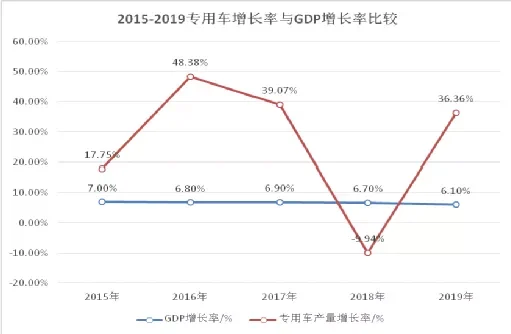
Note: GDP data from the National Bureau of Statistics
Figure 1: Comparison of Special-Purpose Vehicle Output Growth Rate and GDP Growth Rate, 2015–2019
Supply-side structural reform was deepened, reform and opening-up efforts were intensified, and people’s lives continued to improve, maintaining healthy, sustained economic development and overall social stability.
Favorable measures — successive investment in major infrastructure and livelihood projects; the advancement of subsidy policies for new energy special-purpose vehicles; and proactive adjustments to the transport structure, such as winning the battle for blue skies and shifting freight from road to rail — have all stimulated the development of the domestic special-purpose vehicle industry to varying degrees, and domestic special-purpose vehicle products have entered a clear upward trajectory.
Policies and Regulations:
A constant guide to industry development
National policies and regulations have had a profound impact on the special-purpose vehicle industry and, for a time, steered its direction of development.
During the 13th Five-Year Plan period, relevant national policies and standards were successively issued and revised (see Table 1). From the standpoint of standards and regulations, they phased out some vehicle models that seriously affected transport safety and also gave rise to many new products in the industry.
Table 1: Relevant Standards and Regulations Affecting the Industry, 2015–2019
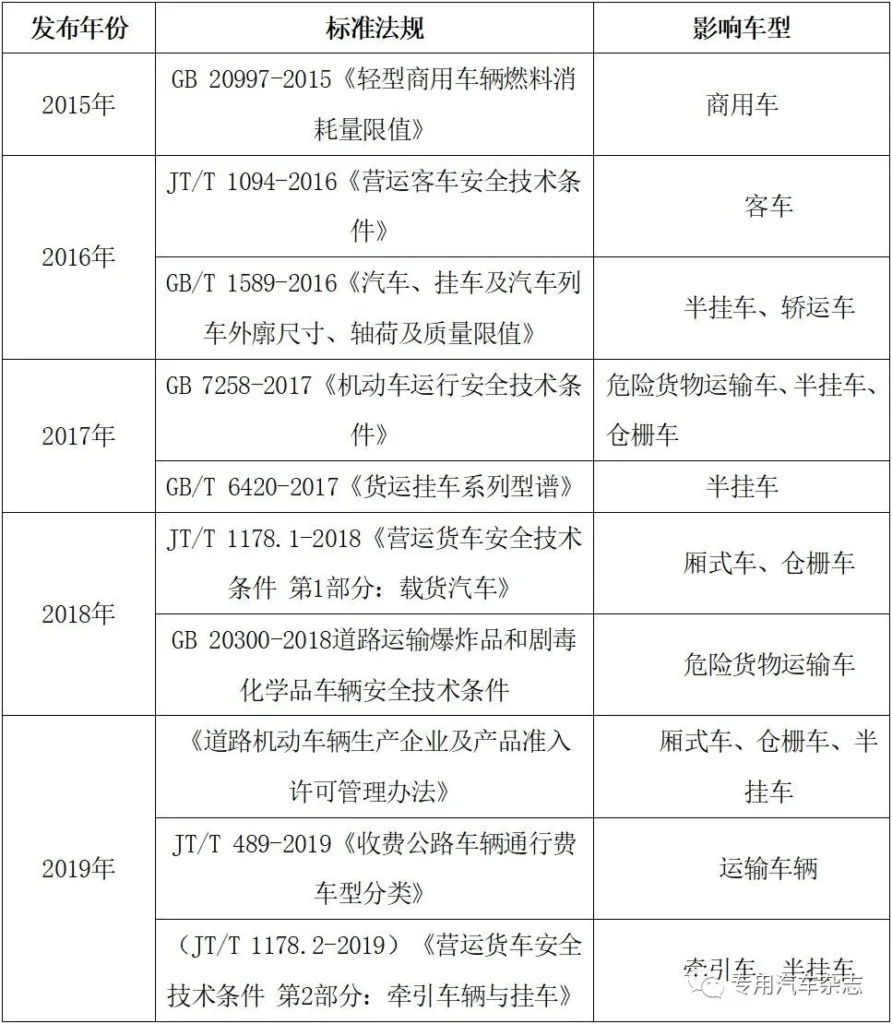
Take GB7258 as an example. From its release to the clause-by-clause implementation of its provisions, it has had a huge impact on the special-purpose vehicle industry: on the one hand, it has driven the industry’s products toward standardization and safety; on the other hand, it has also changed the composition of the industry’s products. The new standard’s higher requirements for the running gear configuration of stake trucks and drop-side trucks have, in turn, spurred the emergence of large numbers of alternative models, such as side-tipping drop-side trucks and curtain-side semi-trailers.
In terms of policy, relevant policies issued by the state may have a positive or negative stimulating effect on the market for the vehicle models concerned, affecting market demand accordingly.
For example, in recent years the state has increased investment in infrastructure construction, and industry demand for the corresponding construction vehicles has remained strong; as the state has stepped up environmental protection and the governance of urban and rural environments, market demand has risen accordingly, which in turn has steered industry capital toward municipal and sanitation products.
Market Demand:
A two-sided impact on the industry
Products of China’s special-purpose vehicle industry mainly serve the fields of logistics and transportation and of urban and rural development, including municipal, construction, medical and road maintenance vehicles, among others.
During the 13th Five-Year Plan period, with steady macroeconomic growth, increased investment in infrastructure construction, accelerating urbanization, rising levels of modernization, rapid development of the logistics and transportation industry, and the effective stimulus of relevant national industrial policies, the room for market demand in the special-purpose vehicle industry expanded further.
In a commodity economy, the relationship between supply and demand determines the price of goods, and it is also a reflection in the market of the relationship between production and consumption.
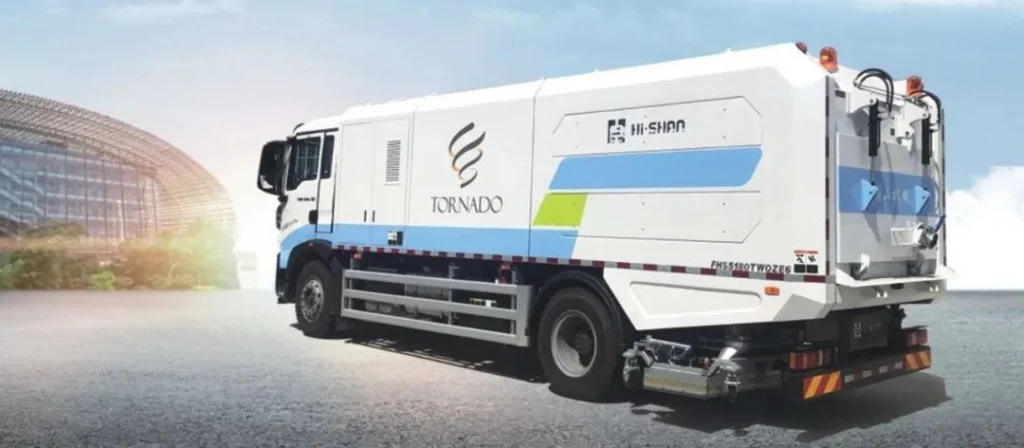
a. Guiding industry development
At present, domestic market demand guides the direction of industry development in two ways: positive guidance and negative guidance.
Positive guidance comes mainly from the market’s requirements for special-purpose vehicle products with high quality and high technological content, which push special-purpose vehicle companies to improve product quality, step up product R&D and raise added value.
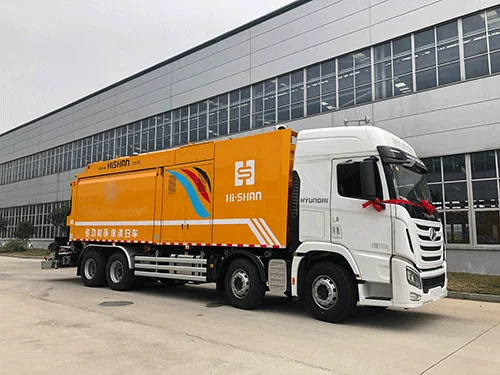
Negative guidance, on the other hand, comes from the market’s demand for low-priced products, which leads to cutthroat competition among special-purpose vehicle companies. To cut product costs, companies are forced to use low-quality, low-priced components and simplified processes, making it difficult to raise the quality level of special-purpose vehicle products.
b. Stimulating new product development
Most products in the special-purpose vehicle industry are developed for the market; guided by new market demand, special-purpose vehicle companies are driven to develop new products that meet market needs.
Source: WeChat official account of Special Purpose Vehicle Magazine